Every modem quotation carries a range figure, and almost every range figure is quoted at the lowest data rate the device can produce, in water the vendor chose. The number is not a lie; it is a link-budget result with the assumptions hidden. This note takes the assumptions out of hiding, using our own source-level calibration and sea-trial data rather than textbook examples, because the arithmetic is the same either way and ours is measured. The full range and rate ladder sits on the UAM series page.
Range is a link budget, not a spec sheet number
A modem link closes when the received level exceeds the noise by enough margin for the modulation and the error-correction to work. Written as a budget:
SNR_received = SL - TL - NLSource level minus transmission loss minus noise level. Every range claim is this equation solved for the largest distance at which the result still clears the required SNR. Change the required SNR, and the range changes even though nothing in the hardware did.
That is why a vendor can quote 4 kbps at 3 km and 100 bps at 10 km for the same box, and why both figures are honest. Lower order modulation needs less margin per symbol and tolerates a weaker signal, so it reaches further at a lower rate. Specifying "10 km" without specifying the rate is specifying nothing.
The four terms that close the link
Source level (SL) is the transmitted intensity, referenced to one micro-pascal at one metre. Ours runs from 166.2 dB at the lowest power setting to 188.6 dB at the highest, a 22.4 dB span across sixteen steps, measured with a calibrated hydrophone and logged in the transmit source level test report.
Transmission loss (TL) has two parts: spreading, which is geometric, and absorption, which is chemical and frequency dependent. In shallow water spreading behaves somewhere between cylindrical (10 log r) and spherical (20 log r). This note uses the cylindrical form, which is the optimistic case and therefore the honest one when you are testing a claim.
Noise level (NL) is the ambient spectrum level integrated over the receiver bandwidth. Shipping and wind dominate the 8–16 kHz band; biologics and rain matter more above 20 kHz. A typical open-sea spectrum level at 10 kHz sits in the 50–60 dB re µPa²/Hz region depending on wind and traffic; that is a class description, not a measurement, and any site survey should replace it with a number.
Required SNR is set by the modulation, the coding and the acceptable error rate. Our family is specified at 10⁻⁴ BER, and in practice a working link wants 10 dB of margin or more once fading is present.
Absorption is the term that scales with frequency
Absorption is where the physics gets expensive. The Thorp relation gives a working estimate in dB per kilometre for a frequency in kHz:
alpha(f) = 0.11 f^2/(1+f^2) + 44 f^2/(4100+f^2) + 2.75e-4 f^2 + 0.003| Frequency | 4 kHz | 8 kHz | 12 kHz | 16 kHz | 32 kHz | 50 kHz |
|---|---|---|---|---|---|---|
| Absorption (dB/km) | 0.28 | 0.81 | 1.64 | 2.77 | 9.19 | 17.47 |
Read the table left to right and the product family explains itself. The 4–8 kHz band loses about a quarter of a dB per kilometre, so the 30 km series can afford long paths, and it pays for them in bandwidth: 100 bps to 1 kbps. The 16–32 kHz band loses 9 dB per kilometre at its upper end, which is why the 3 km series exists and why it can carry 4 kbps. Between the two, 8–16 kHz buys 10 km at a few kbps.
Doubling the carrier frequency does not double the loss. From 8 to 16 kHz it goes from 0.81 to 2.77 dB/km, a factor of 3.4. That factor, not the transmitter, is what decides which band your application belongs in.
What doubling the transmitter power actually buys
The intuition most buyers bring is that more power means more range. Run the numbers with our own measured source levels.
Take a 16 kHz link, 3 kbps, a 4 kHz occupied band, 91 dB of in-band noise, and 10 dB of required SNR. The allowable loss is 182.8 − 91 − 10 = 81.8 dB at the mid power setting. Solving spreading plus absorption puts the limit near 23 km in an ideal channel. Now wind the power from the lowest setting to the highest: +22.4 dB of source level.
16 kHz: TL(r) = 10 log10(r) + 2.77 r     -> 10 km becomes about 17 km
 8 kHz: TL(r) = 10 log10(r) + 0.81 r     -> 10 km becomes about 31 km
Twenty-two decibels, the entire power range of the hardware, buys roughly seventy percent more distance at 16 kHz and roughly three times the distance at 8 kHz. And if you only double the power, which is +3 dB, the 16 kHz link gains about 0.95 km while the 8 kHz link gains about 2.5 km.
The conclusion is uncomfortable but useful: power is the weakest lever you have, and frequency is the strongest. Budgeting for a 15 km link at 16 kHz by buying a bigger amplifier is the wrong purchase. Moving to the 8–16 kHz band, or accepting a lower data rate, is the right one.
Multipath: the tax that appears in shallow water
Absorption and spreading describe a channel that does not exist. Real shallow water sends the same symbol along several paths, and the arrival times differ.
At 20 m water depth with both transducers at 10 m and a 100 m separation, the surface reflection travels about 2 m further than the direct path, which is roughly 1.3 ms of delay. A 6 kbps link has a symbol period near 0.17 ms, so that reflection lands eight symbols late. The receiver sees inter-symbol interference, not a clean pulse. At 1 km separation the same reflection is only 0.2 m longer, which is why multipath is a near-range problem that surprises people who tested in deep water.
Our 2025 trials show the effect rather than the theory. In the Weihai range trial, the link held bidirectional at 9.7 km and one-way at 10.4 km with 21 dB of received SNR, and beyond 10 km the failures clustered in the 10 kHz and 13–14 kHz slices of the band: frequency-selective fading, where the delay spread cancelled specific subcarriers while neighbours survived.
Doppler is the second tax. A vehicle at 2 m/s shifts the carrier by about 0.13 percent, which is 16 Hz at 12 kHz and 43 Hz at 32 kHz. Small in absolute terms, awkward relative to subcarrier spacing, and the reason high-rate links on moving platforms need resampling rather than a wider band. The practical countermeasures are summarised in the multipath and Doppler discussion.
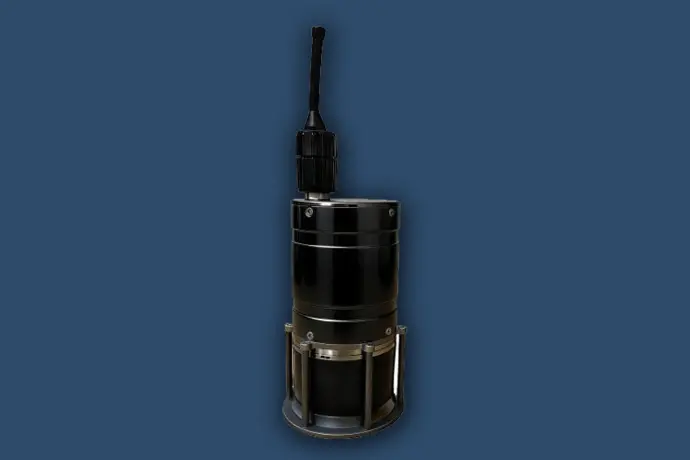
Our range and rate ladder, read as a family
The catalogue is a set of answers to the same budget question, solved under different frequency constraints.
| Series | Band | Nominal range | Rate | Modulation | Depth rating | Transmit power |
|---|---|---|---|---|---|---|
| UAM-04080X | 4–8 kHz | 30 km | 100 bps – 1 kbps | MASS / SC-MPSK | 6,000 m | up to 300 W |
| UAM-08160X | 8–16 kHz | 10 km | 100 bps – 4 kbps | MASS / SC-MPSK | 300 / 4,000 / 6,000 m | up to 120 W |
| UAM-08160H | 8–16 kHz | 10 km at 3 kbps | 3–6 kbps | OFDM | 300 / 2,000 / 6,000 m | 60 W |
| UAM-16320X | 16–32 kHz | 3 km | 100 bps – 4 kbps | MASS / SC-MPSK | 300 m | up to 40 W |
| UAM-16320H | 16–32 kHz | 2 km | 8 kbps | OFDM | 6,000 m | 60 W |
Two patterns are worth naming. First, the power column falls as the band rises: 300 W in the 4–8 kHz series against 40 W in the 16–32 kHz series. That is not a cost decision, it is physics; the low band needs brute force to be heard over a noisy, shipping-dominated spectrum, and the high band spends its budget on bandwidth instead of distance.
Second, two rows share the 8–16 kHz band with different answers. The 08160X uses a dual-mode single-carrier scheme and reaches 10 km at low rates; the 08160H uses OFDM and holds 3–6 kbps out to 10 km, with 4.5 kbps at 5 km and 6 kbps at 3 km. Same band, different modulation, different trade.

Specifying a link that survives the site
A range number that survives deployment is built from five questions, answered in this order.
What data rate do you actually need, and how often? A seabed node reporting a burst of sensor records every hour is not the same customer as a vehicle streaming sonar at 6 kbps continuously. Duty cycle changes both the required rate and the power budget.
How deep, and how is it housed? Depth rating is the one specification that fails catastrophically rather than gracefully: 300 m aluminium, 2,000 m stainless, 6,000 m titanium in the 08160H line, and a 6,000 m rating with a 600 m design margin in the 04080X series.
Will the two ends ever move? Half-duplex turnaround, Doppler and fading all degrade with motion. A moored pair at 9 km is easier than a vehicle pair at 1 km.
What is the ambient noise at the site? Fishing traffic, rain and biologics move the noise floor more than wind in the band you are using. Our ocean-noise background trial shows the same link swinging from zero packet loss to 20–25 percent as the transducers were moved between 5, 8 and 10 m in 20 m water — depth placement, not power, decided the outcome.
Does the battery survive the schedule? Take a 48 V, 7 Ah pack, 336 Wh, behind a modem that transmits at 60 W and receives at 1.7 W. Continuous transmit empties it in 5.6 hours; continuous receive lasts about 198 hours. A realistic duty cycle of one percent transmit, ten percent receive and the rest on standby draws 0.79 W average, which is about 426 hours, roughly eighteen days. That number, not the range figure, is usually what the deployment plan actually depends on.
The battery arithmetic also explains the standby figures in the family: 20 mW on standby is what makes multi-month deployments possible, and the difference between 20 mW and 1.7 W is the difference between a year and two weeks.
FAQ
My vendor quotes 10 km. Why did I get 3 km?
Most often because the quote was made at the lowest rate in the band, in deep water, with the transducers clear of boundaries and no traffic. Move to 6 kbps, put the transducers near the surface in 20 m water, and the same hardware gives you a far shorter link. Ask for the range at your rate, not at the minimum rate.
Does a higher frequency always mean shorter range?
In absorption-limited water, yes, and by more than most people expect: 8 to 16 kHz costs a factor of 3.4 in dB per kilometre. But it buys bandwidth, smaller transducers and better directivity, which is why 16–32 kHz is the right band for 8 kbps over 2 km and the wrong band for telemetry over 10 km.
Can I just add a relay?
Yes, and relays are the standard answer when a single hop will not close. Two 5 km hops at a couple of kbps usually beat one 10 km hop at 100 bps, and the arithmetic is the same budget applied twice. The cost is a second platform, a second battery and a second failure point.
How do I test a link before buying?
Ask for three things: the source level at the power setting you will use, the measured range at your data rate, and the received SNR during that test rather than only the pass or fail result. Our 6.17 km reservoir trial publishes exactly those numbers, including the direction that lost 5.76 percent of packets at 33 dB SNR, because a link that only works one way is not a link.
What about ice, harbours and heavily trafficked water?
Those sites raise the noise floor and add boundary reflections rather than changing the physics. They reduce margin, so specify a higher transmit level and a lower rate, and plan for packet retransmission rather than assuming a clean channel. More on the band choices is collected on the underwater acoustic communication blog, and the open question of what limits range in practice is discussed in the modem forum.


What Actually Limits Underwater Acoustic Modem Range