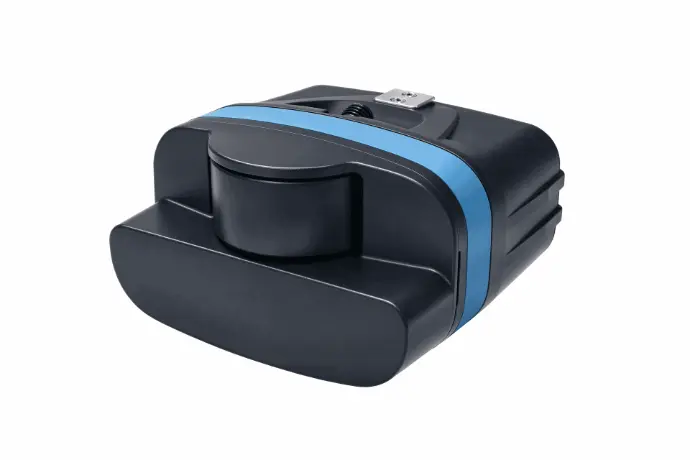
A camera on an ROV is useless in water that carries no light, and that is most of the water an ROV works in. A forward-looking sonar turns the same scene into an acoustic image, and the numbers that decide how good that image is are not the ones printed largest on the datasheet. Beam count, angular resolution and refresh rate at range are what separate a pilot's tool from a passenger's distraction. This note works through the MiniUAC forward-looking family, from a 1 kg shallow-water unit to an 11 km deep-sea housing.
Why an ROV needs a forward-looking sonar at all
Sonar is not a camera substitute, it is a different instrument. It reports range and bearing to an impedance boundary in water that a lens cannot penetrate, and it does so at ranges beyond the reach of any lamp. In a harbour with two metres of visibility, a forward-looking sonar sees a piling at forty metres; in a turbid river it sees a debris field the camera renders as brown fog.
The cost is interpretation. A sonar image is a fan of ranges at bearings, not a perspective view, and the pilot has to read the geometry from the shape of the return. That is why the two specifications that matter are angular resolution and refresh rate: one decides how much structure is in the picture, the other decides how current the picture is.
A useful way to hold both: the sonar is a range-and-bearing sensor, and every question about image quality reduces to how finely it samples each axis and how often.
Beams and angular resolution: what you can tell apart
The MiniUAC-1303 has 512 beams across a field of view of about 110°, widening to 130° on some models. Divide and you get roughly 0.25° per beam. That is the sampling pitch, and it converts to a physical spacing at any range:
| Range | Beam-to-beam spacing at 0.25° | What it means |
|---|---|---|
| 5 m | 2.2 cm | a bolt head is resolvable |
| 40 m | 17 cm | a pipe is resolvable, a cable is not |
| 120 m | 53 cm | two objects half a metre apart merge into one |
The table is the whole argument for flying close. At 120 m the sonar is sampling the scene every half metre, so a target smaller than that is a single bright pixel regardless of the 5 mm range resolution. Range resolution tells you how thin a slice of the return is; angular resolution tells you how far apart two things have to be before they are two things.
The 1303's individual element beamwidths run from under 1.6° at 200 kHz to under 0.3° at 1.2 MHz, and that is a second, separate number. Element beamwidth sets the size of each acoustic footprint; beam spacing sets how the fan is sampled. A narrow element with wide spacing oversamples and gives a smooth image; a wide element with narrow spacing gives a blurred one. In this family the ratio is chosen so the two roughly match, which is why the quoted beamwidths track the frequency so closely.
Frequency selection: 200 kHz to 1.2 MHz in one housing
The 1303 family spans eight models from 200 kHz to 1.2 MHz in the same 260 × 68 × 106 mm housing, with the same 512-beam architecture and the same power budget of about 30 W average. The range and the field of view are what change:
| Model | Frequency | Beam | Max detection | Best use |
|---|---|---|---|---|
| A0200 | 200 kHz | <1.6° | >330 m | long-range awareness |
| A0300 | 300 kHz | <1.2° | >250 m | mid-range search |
| A0400 | 400 kHz | <0.9° | >205 m | general ROV navigation |
| A0750 | 750 kHz | <0.5° | >120 m | close inspection |
| A1200 | 1.2 MHz | <0.3° | >60 m | detail at short range |
Higher frequency buys angular resolution and costs range, in water that absorbs more of it. The physics is the same one behind every sonar choice on this site: absorption rises with frequency, so the same source level reaches less far. A 1.2 MHz channel sees a 65° field of view out to 60 m; a 200 kHz channel sees 110° out to 330 m. Neither is better, and the choice is a statement about the mission.
Two frequency channels in one unit, as the dual-frequency models offer, is the practical answer: run the low channel for situational awareness and the high channel for the final approach. The FLS800D does this at 850 kHz and 1150 kHz with online switching and a simultaneous display, and the 1303 offers the same in its dual-channel versions.

Range, refresh and the speed limit
Refresh rate is quoted at a working range, and the working range is the qualifier that gets lost in the brochure. The 1303 gives at least 4 Hz at 150 m; the deep-sea 1310 and 1311 give up to 40 Hz depending on range; the FLS800D also reaches 40 Hz at short range.
The physical ceiling is the round trip. Two-way travel time at 120 m is 0.16 s, so a single-pulse system cannot exceed about 6 Hz at that range; 40 Hz requires short ranges and parallel beam processing. At 15 m the ceiling is 50 Hz, which is why the high refresh figures always come with a short-range qualifier.
Now put the vehicle in the water. At 6 knots, which is 3.09 m/s, a 4 Hz update means the ROV covers 0.77 m between frames. At 10 knots it covers 1.29 m. On approach to a structure, that is the distance over which the sonar image is stale, and it is the number an ROV pilot feels rather than reads.
Hence the speed ratings. The 1310 is limited to 6 knots and notes that higher speeds degrade detection range rather than stopping the sonar. The FLS2040 recommends 6 knots with a 10 knot maximum. These are not structural limits, they are image-quality limits stated as speed.
2.5D: measuring height instead of guessing it
A conventional forward-looking sonar produces a fan in the horizontal plane and tells you that something is at 8 m bearing 20°. It does not tell you how tall the object is, so a pipeline and a boulder look alike until you change aspect.
The MiniUAC-1402 adds vertical beam steering from 1.5° to 45°, with beamwidth adjustable between −22.5° and +22.5°, on a 1 MHz channel with 1.2° horizontal beamwidth, 256 beams and 2.5 mm range resolution. Steering the beam up and down through a target lets the software triangulate its height above the seabed:
height ≈ range × sin(elevation)
10 m at 15°  → 2.59 m
30 m at  5°  → 2.62 m
The same height is measured at 10 m with a steep look and at 30 m with a shallow one, which is why the steering range spans both. It also lets the operator suppress the seabed return by steering the beam above it, which is the difference between seeing a target on a flat bed and seeing it against a clutter background.
The 1402 is a 300 m, 400 g unit drawing 9 W average, so it is a close-inspection instrument rather than a search sonar. Pair it with a 1303 for search and you get the useful combination: long-range awareness from one head, height and seabed rejection from the other.
Depth rating, power and the payload budget
The family spans three depth classes, and the housing material is what changes:
- 300 m aluminium: 1303 in aluminium at 2.5 kg in air and 1 kg in water, 1402 at 1.1 kg / 400 g, 850A at 1.3 kg with a neutral-buoyancy option.
- 1,000 m titanium: the same 1303 head at 4.5 kg in air and 3 kg in water; FLS800D rated to 400, 600 or 1,000 m at 1.3 kg in air and 410 g in water.
- 6,000 m and 11,000 m: 1310 and 1311 in a 120 × 100 mm housing at 3 kg in air and 2 kg in water, with 768 beams.
Power is the other constraint a small ROV cares about. The 1303 averages about 30 W with an 80 W peak, the deep-sea pair about 16 W with a 50 W peak, the 1402 about 9 W, and the FLS2040 up to 100 W average. On a battery-powered observation-class ROV, a 30 W sonar is a meaningful fraction of the hotel load; on a work-class vehicle with a 3 kW hydraulic pack it is nothing. Specify against the vehicle, not against the sonar.
The 18–50 VDC input range across the family is worth noting because it means the same head runs from a 24 V battery bank or a 48 V DC bus without a converter. That is one less box in the pressure can.
Turbid water, blind zones and what the sonar cannot do
Three limits are worth stating plainly, because each one has a workaround and none has a fix.
The blind zone. The 1303 family is quoted at ≤0.3 m, the 850A and FLS2040 at ≤1 m. Inside that distance the sonar cannot separate transmit from receive, so the last 30 cm of an approach is blind. Docking, tool placement and contact work need a camera or a mechanical reference for the final move, and a pilot who expects the sonar to cover it will bump the structure.
The minimum range setting. The 1402's range can be set from 2 m, the FLS800D quotes 0.1 m minimum range, and the 850A works as a diver-held unit at 80 m maximum. These are different instruments for different standoff distances, and quoting a maximum range without the minimum is quoting half a specification.
The acoustic environment. Detection range is quoted for a favourable hydrological condition and a stated target strength — the 850A specifies −15 dB, the FLS2040 notes that range depends on target strength, hydrology and sediment. In heavy suspended sediment, range falls; over a soft mud bottom, the seabed return can swamp a small target. The 2.5D steering exists partly for this reason.
What the sonar does well is the thing no lamp can do: give geometry at range through water that carries no light. What it does not do is colour, texture or fine identification. A pilot who treats the sonar as the primary instrument for geometry and the camera as the primary instrument for identification gets the best of both.

FAQ
How many beams do I need?
Enough that the beam spacing is finer than the smallest feature you need to see at your working range. At 0.25° spacing, objects closer than 53 cm merge at 120 m and closer than 2.2 cm merge at 5 m. Beam count is a means to that spacing, not a specification in itself.
Is a higher frequency always better for imaging?
No. Higher frequency gives a narrower beam and better angular resolution, and loses range to absorption. A 1.2 MHz channel reaches 60 m with a 65° field of view; a 200 kHz channel reaches 330 m with 110°. Dual-frequency units exist so the same head can do both jobs.
Why is the refresh rate qualified by range?
Because the round trip sets the ceiling. At 120 m the echo takes 0.16 s to return, so a single-pulse system tops out near 6 Hz. The 40 Hz figures apply at short range, where the round trip is short enough to support them.
What does 2.5D actually add over 2D?
Height. A 2D fan gives range and bearing, so a pipeline and a boulder at the same range look similar. Vertical beam steering lets the software triangulate an object's height above the seabed and reject the seabed return, which is what makes close inspection quantitative rather than interpretive.
Can the sonar be mounted on a small observation ROV?
Yes, with the power budget in mind. The 1402 draws about 9 W, the 850A 18 W, and the 1303 about 30 W average. The constraint on a small vehicle is hotel load and mass, not depth rating — the aluminium 1303 is 1 kg in water and rated to 300 m.

ROV Forward-Looking Sonar: Beams, Range and Refresh