Overview
Long-range acoustic communication in shallow water is heavily constrained by multipath propagation, frequency-selective fading, and bathymetric blockage. This report documents the field evaluation of the UAM-08160H High-Speed Underwater Acoustic Modem across extended ranges off the coast of Weihai, Shandong Province, China.
The trial was conducted on November 23, 2025, between 12:00 and 17:00, targeting communication paths from 6 km up to 10.4 km. Empirical results demonstrate that the UAM-08160H achieved dynamically stable communication at 8 km, stable bidirectional communication at 9.7 km, and stable one-way telemetry at 10.4 km (with a receiver SNR of 21 dB).
1. Test Setup & Location Coordinates
- Test Location: Offshore waters near Sunjiatuan, Weihai City, Shandong Province, China
- Date & Schedule: November 23, 2025, from 12:00 to 17:00
- Scope: Evaluation of UAM-08160H long-range telemetry limits and shallow-water channel behavior
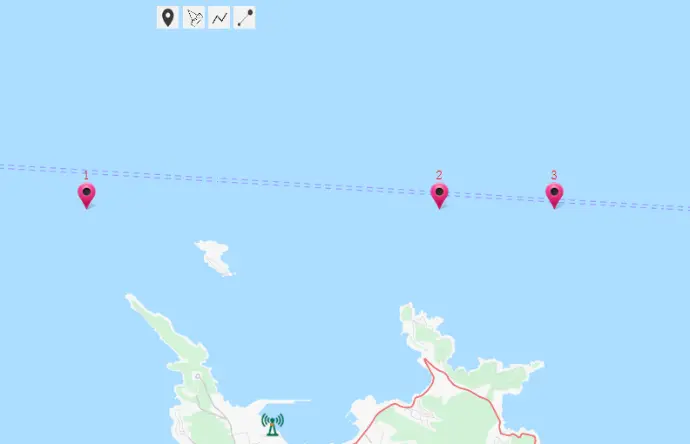
Key Node Coordinates
- Transmitter / Base Point (UUV1-P1): N37.57879°, E122.0542°
- 6 km Reference Point (UUV3-P1): N37.57879°, E122.1237°
- 8 km Reference Point (UUV3-P2): N37.57879°, E122.1463°
2. Chronological Field Timeline
Testing proceeded by incrementally increasing node separation across the designated sea area:
- 12:20 | Arrived at the initial site with a 6 km node spacing; CTD casts were performed to record hydrological profiles.
- 12:40 & 12:46 | Successful two-way acoustic telemetry links were established at 7 km and 7.5 km, respectively.
- 12:50 | Acoustic communication failed entirely. Diagnosis: Vessel drift caused the acoustic line-of-sight path to be shadowed by a nearby island.
- 13:07 – 15:30 | Positions were adjusted to clear bathymetric shadowing. Telemetry tests across 6.5 km to 8.2 km confirmed consistently stable communications.
- 15:50 | At a distance of 9.2 km, the topside computer successfully demodulated packet transmissions.
- 16:09 | At a distance of 9.7 km (ship-to-ship), the topside system demodulated packets correctly. Signal structure was clear in the frequency domain, though time-domain pulses were less distinct.
- 16:15 | At a distance of 10.2 km (ship-to-ship), successful demodulation was maintained.
- 16:18 & 16:24 | With the submersible navigating at a fixed depth of 5 m, the telemetry link reached 10.4 km. The receiving topside computer demodulated correctly, recording a Signal-to-Noise Ratio (SNR) of 21 dB. Frequency response analysis revealed uneven spectral amplitude and marked frequency-selective fading around 10 kHz and 13–14 kHz.
3. Key Findings & Performance Summary
- Dynamic Stable Range: Achieved stable communication while in motion at 8 km.
- Bidirectional Range Limit: Maintained reliable two-way communication at 9.7 km.
- Maximum One-Way Range: Achieved one-way demodulation at 10.4 km (SNR = 21 dB at 5 m fixed operating depth).
- Acoustic Channel Behavior: At distances exceeding 10 km in shallow water, severe multipath interference causes notable frequency-selective fading (specifically in the 10 kHz and 13–14 kHz bands). The UAM-08160H's physical layer algorithms reliably decoded packets under a 21 dB SNR despite spectral notches, confirming strong resilience against channel distortion.
Related UAM Product series
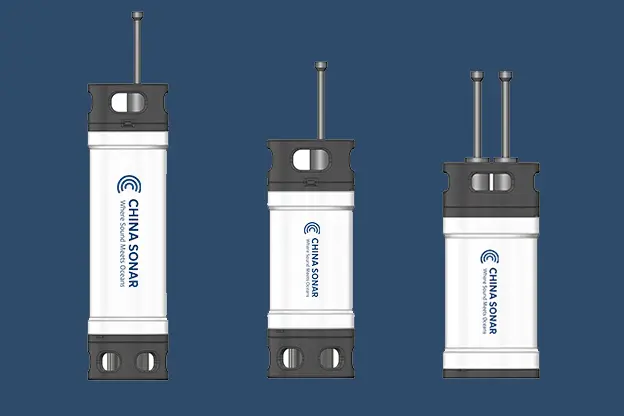
UAM-16320X
Frequency: 16kHz-32kHz
Communication Distance: 3km
Communication Rate:100-4kbps
Operating Range: 300m
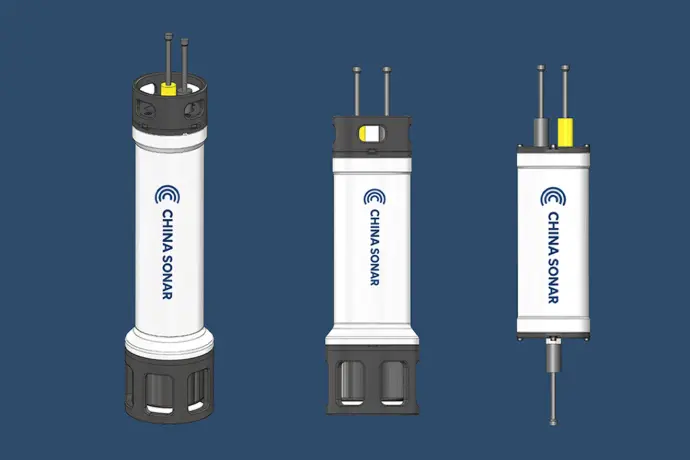
UAM-08160X
Frequency: 8kHz-16kHz
Communication Distance: 10km
Communication Rate:100-4kbps
Operating Range: 300-6000m
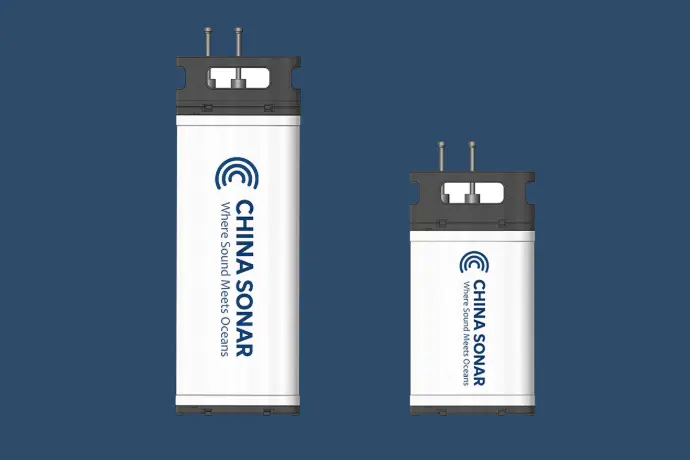
UAM-04080X
Frequency: 4kHz-8kHz
Communication Distance: 30km
Communication Rate:100-1kbps
Operating Range: 6000m
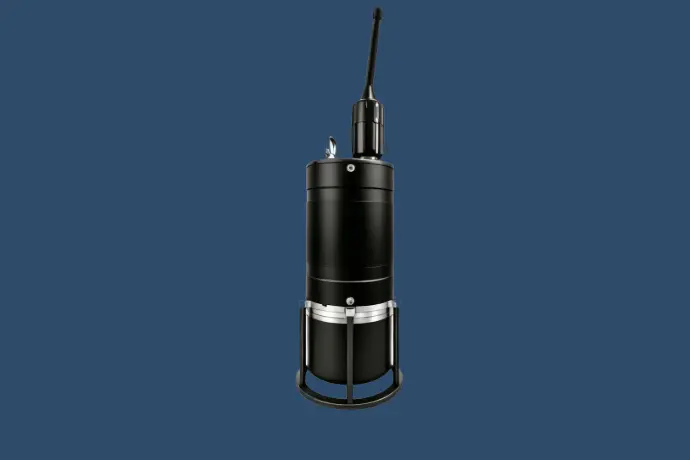
UAM-08160H
Frequency: 8kHz-16kHz
Communication Distance: 10km
Communication Rate: 3–6 kbps
Operating Range: 300-6000m
UAM-08160H Underwater Acoustic Modem Range Test Report