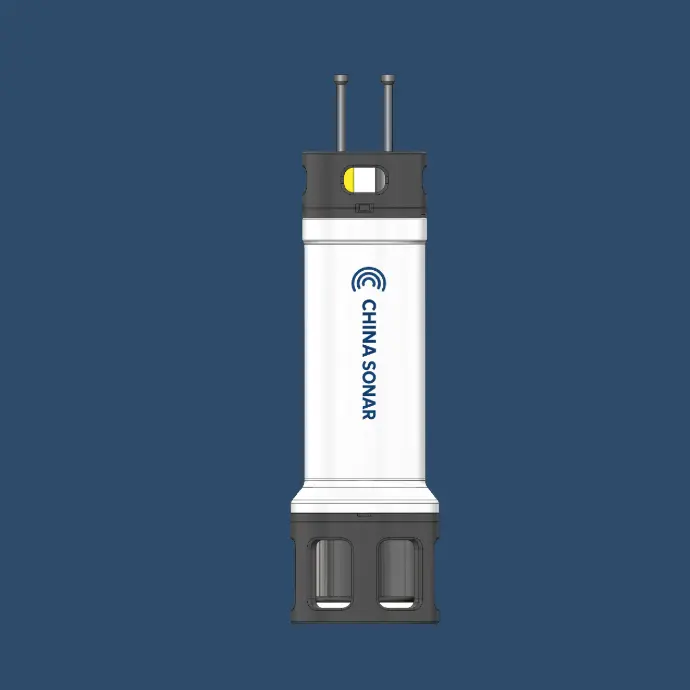
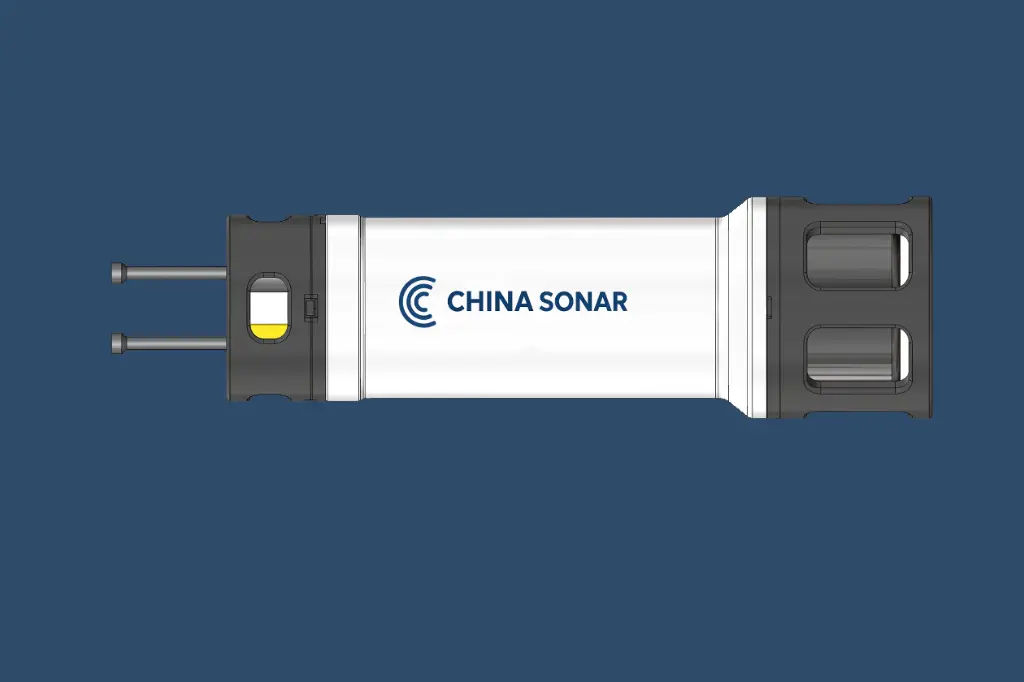
UAM-08160X-IE3S
10KM Long-range Underwater Acoustic Modems (UAMs) ,
Built-in duty module / Long-term observation / Externally powered / 4000m
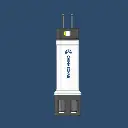
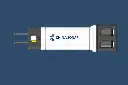
The UAM-08160X-IE3S is an underwater acoustic modem device specifically designed for long-term observation platforms such as seabed bases and buoys. Externally powered, the device features a user-customizable battery compartment, allowing flexible adaptation to diverse mission requirements. It is capable of operating at depths of up to 4000 meters, providing a maximum communication range of 10 km and supporting a user data rate of up to 4 kbps with a bit error rate of 10⁻⁴.
| Communication Frequency Range: 8kHz-16kHz |
| Communication Distance: Up to 10km |
| Communication Rate: 100bps-4kbps |
| Bit Error Rate: 10⁻⁴ |
| Operating Modes: Transmit Mode/Receive Mode/Standby Mode |
| Communication Type: Half-Duplex |
| Communication Standard: Dual-Mode(MASS/SC-MPSK) |
| Maximum Working Depth: 4000m(with a design margin of 600m) |
| Standby Power Consumption: 20mW |
| Receive Mode Power Consumption: 3.6W |
| Transmit Mode Power Consumption: up to 120W(with adjustable power levels) |
| Power Supply Voltage: DC 24V |
| Control Interface: RS485/RS232/RS422 |
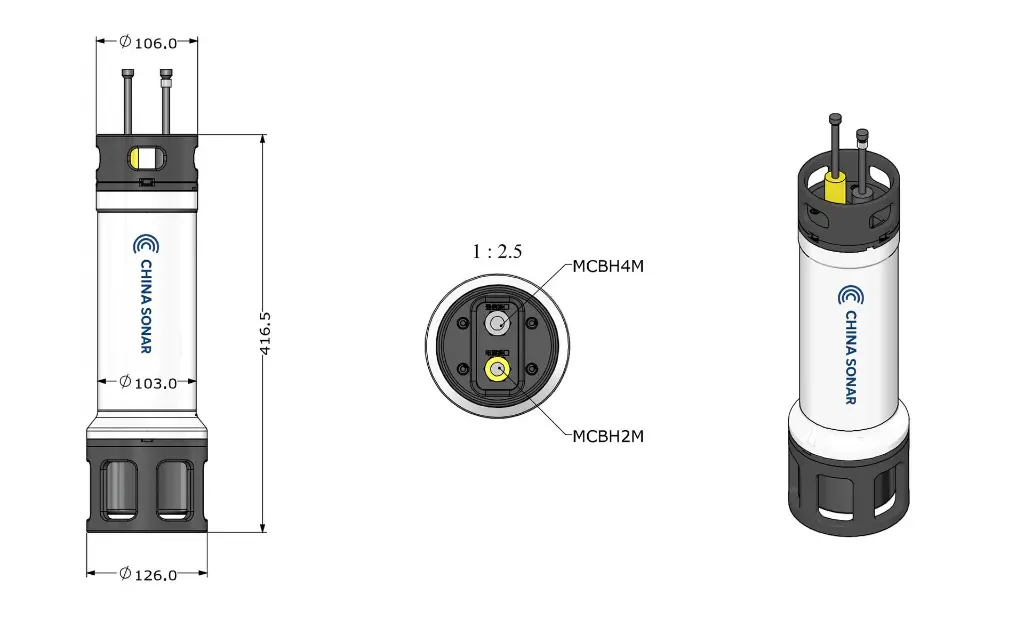
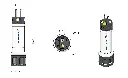
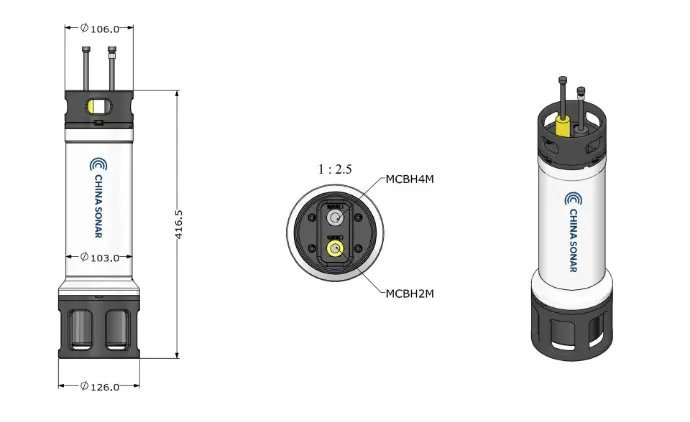
| Dimensions: Diameter 126mm × Height 420mm |
| Weight: 12kg(in air)/8.6kg(in water) |
Key Features
- Deep-Sea Deployment
Operates at depths up to 4000 meters, covering the majority of subsea communication needs in the South China Sea and beyond. - Durable Construction
Built with a monolithic 2205 stainless steel housing, offering superior corrosion resistance and long service life. - Flexible Power Options
Externally powered, with a user-configurable battery compartment to adapt to different mission requirements. - Reliable Long-Range Communication
Supports up to 10 km underwater communication with a maximum data rate of 4 kbps (BER 10⁻⁴). - Standard Protocol Support
Equipped with an RS232 serial port and compliant with standard control protocols, with technical support available for custom protocol development.
Applications
- Seabed observation stations
- Buoy communication systems
- Underwater sensor networks
- Ocean monitoring & data transmission
- Offshore engineering and long-term research missions
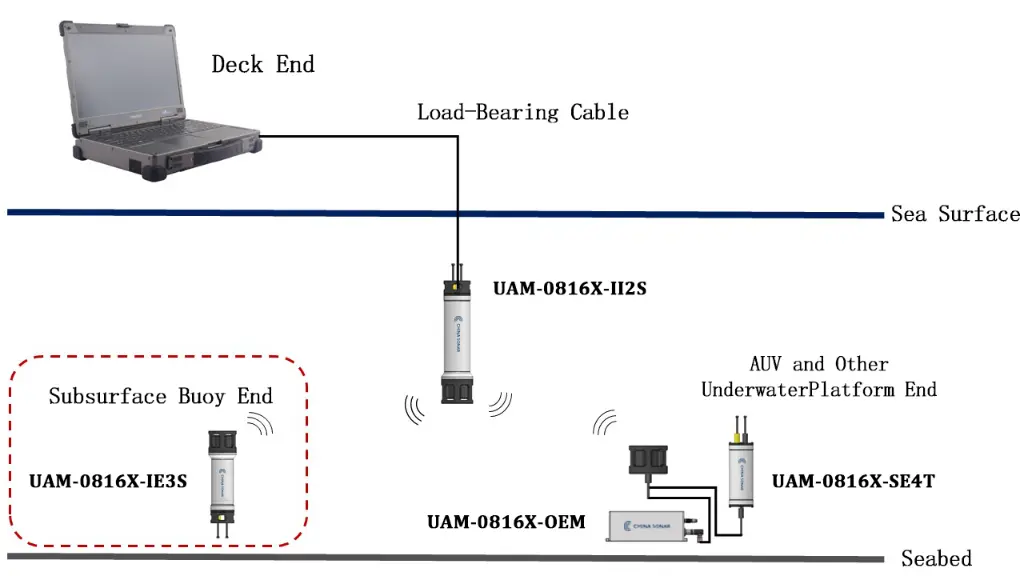
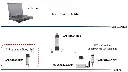
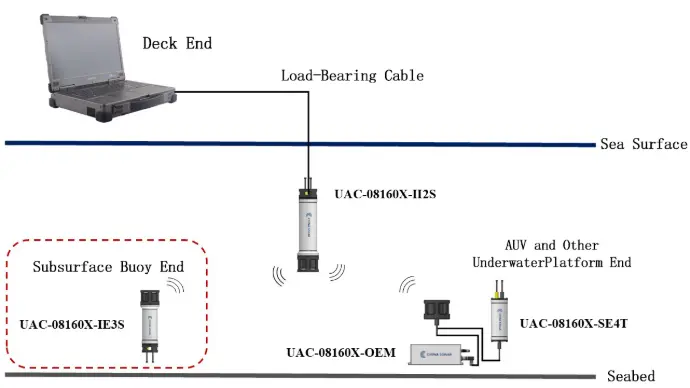
Application Diagram
Explore the UAM-08160X Series
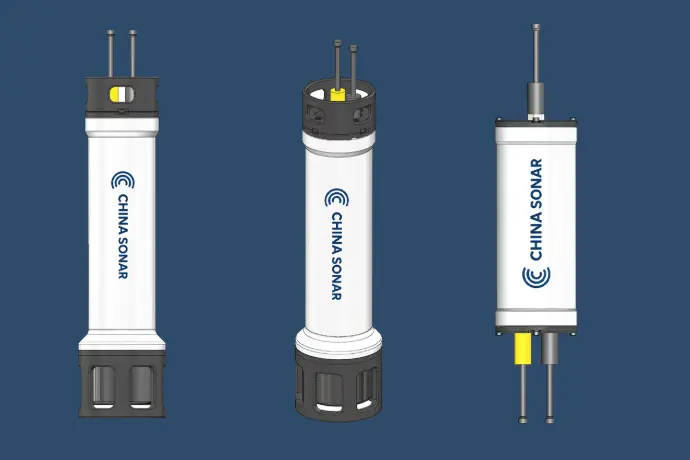
The UAM-08160X Series includes the portable II2S, the 4000 m-rated IE3S, the 6000 m deep-sea SE4T, and the highly integrable OEM system solution. Whether for shallow-water trials, coastal monitoring, or deep-sea engineering and system integration, the UAM-08160X Series delivers reliable performance for diverse underwater acoustic communication needs.
Related Products
UAM-08160X-II2S
Frequency: 8kHz-16kHz
Communication Distance: 10km
Communication Rate:100-4kbps
Bit Error Rate:
10⁻⁴
Operating Range: 300m
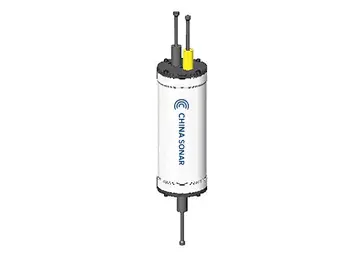
UAM-08160X-SE4T
Frequency: 8kHz-16kHz
Communication Distance: 10km
Communication Rate:100-4kbps
Bit Error Rate:
10⁻⁴
Operating Range: 6000m
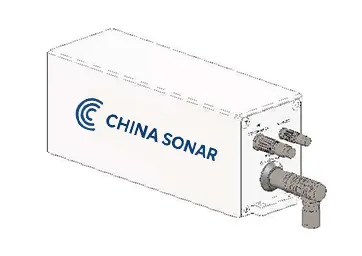
UAM-08160X-OEM
Frequency: 8kHz-16kHz
Communication Distance: 10km
Communication Rate:100-4kbps
Bit Error Rate:
10⁻⁴
Operating Range: ≤6000m
How the UAM-08160X-IE3S Works
The UAM-08160X-IE3S is a high-performance underwater acoustic communication device engineered for deep-sea and mid-water subsea communication where radio frequency (RF) and optical signals are ineffective. It enables robust, long-range transmission as part of advanced underwater acoustic modems.
Signal Conversion & Modulation
- Data from buoys, autonomous underwater vehicles (AUVs), subsea sensors, or oceanographic platforms is converted into digital form.
- The system supports dual-mode modulation (MASS / SC-MPSK), loading the digital data onto acoustic carriers in the 8–16 kHz frequency band, which is optimized for underwater acoustic communication.
Transmission & Propagation in Water
- Once modulated, acoustic wave transmission is emitted into the water medium. These signals can reach up to 10 km under optimal conditions, with data rates between 100 bps and 4 kbps and a bit error rate (BER) around 10⁻⁴.
- The device operates in half-duplex mode, switching between transmit and receive to conserve power and manage communication flow.
- Deep-sea propagation effects—such as attenuation, multipath reflections from the seabed and surface, pressure (depth), temperature, and salinity variations—are mitigated through advanced signal processing and robust hardware design in the UAM-08160X-IE3S underwater acoustic system.
Reception & Data Recovery
- A hydrophone captures incoming underwater acoustic signals.
- Received signals undergo demodulation to recover the original digital data, whether for telemetry, sensing, or command/control.
- The system ensures high integrity and low error rates in subsea sensor networks, underwater observatories, or long-term research deployments.
Operational Parameters & Deployment
- Maximum working depth: rated to 4000 meters, with design margin for deeper deployment, enabling use in deep-water oil & gas, cable-and-pipe laying, and oceanographic research.
- Interfaces: RS-232, RS-485, RS-422 for control and data link, allowing integration with existing underwater communication systems or custom underwater acoustic modem networks.
- Power & Modes: Low standby power consumption, higher power during transmission, with adjustable power levels for varying mission profiles.
Typical Application Scenarios
- Seabed observation stations and deep-mid water moorings.
- Buoy communication systems and data relays.
- Underwater sensor networks for environmental monitoring.
- Offshore engineering projects, renewable energy platforms, and long-term oceanographic research vessels.
- Subsea cable and pipeline monitoring in marine communication networks.